Two of the three great Madrid collections give away their last hours. The Prado admits visitors free from six to eight in the evening, Monday to Saturday, and from five to seven on Sundays; the Reina Sofia does the same from seven to nine on Mondays and Wednesday to Saturday. The queues that form for this are long, orderly and worth understanding before you decide what the rest of the day looks like.
Two hours is not enough for the Prado. It is enough for one wing, done properly, and that is a better afternoon than three hours spent walking past everything.
Start where the roads are measured from
In the pavement outside the regional government building on the Puerta del Sol there is a small stone slab marked Kilometro 0. Six of Spain’s national radial roads are measured from that point, and Spaniards stand on it for a photograph in the same slightly self-conscious way people do at any zero marker.
Sol is the transport knot of the city. Metro lines 1, 2 and 3 cross here along with the suburban Cercanias trains, and every walking route in the old centre ends up starting from this square by default.
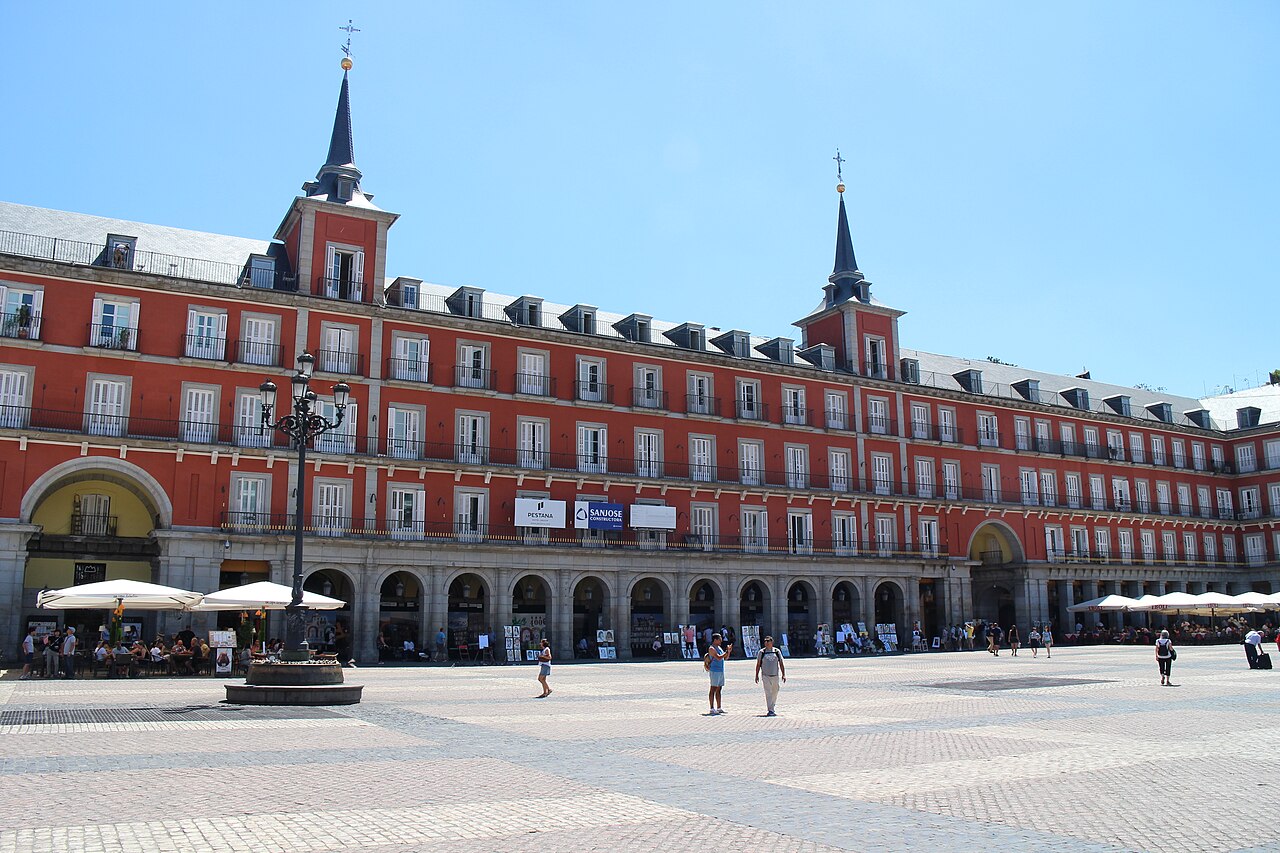
Five minutes west is the Plaza Mayor, a closed rectangle of nine entrances and 237 balconies, built as the city’s ceremonial square and used for everything from bullfights to public executions by the Inquisition. It now holds a stamp and coin market on Sunday mornings.
Do not eat on the square itself. The terraces inside the arcade charge for the setting, and every Madrid resident knows it.
The market question, answered honestly
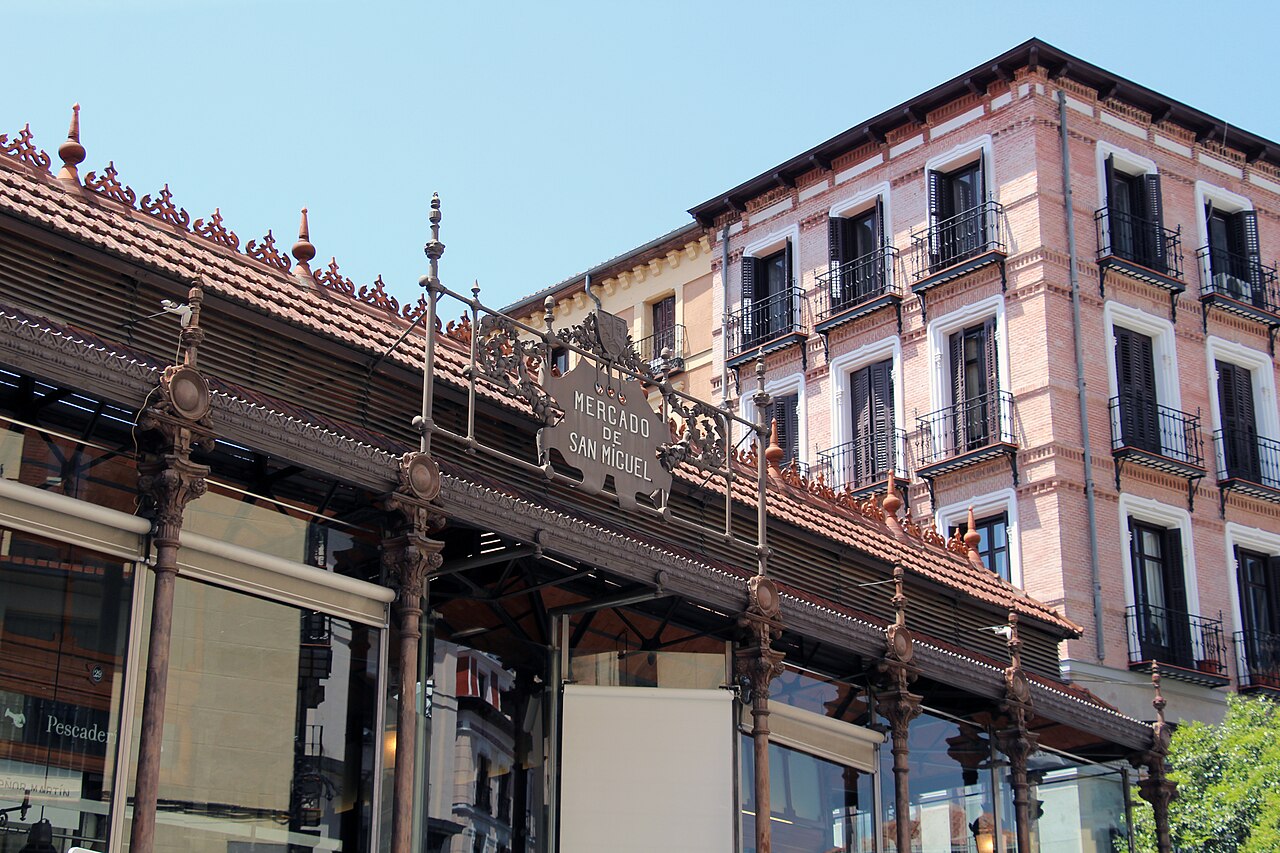
The Mercado de San Miguel, a minute from the Plaza Mayor, is a beautiful 1916 iron and glass hall that stopped being a food market in 2009 and became a food court with high prices. It is enjoyable and it is not a local haunt, and anyone telling you otherwise is reading from a press release.
If a real market is what you want, the Mercado de la Cebada in La Latina or the Mercado de Maravillas in Cuatro Caminos are working ones, with fishmongers who shout and prices that are not aimed at visitors. Maravillas has over 200 stalls and almost no English.
The difference costs about twenty minutes on the metro, and the metro here is fast, cheap and air-conditioned, which matters in July when the street temperature passes 38 degrees and the city empties out. Madrid in August is a genuinely different place: shops shuttered for the month, whole streets closed, the residents gone to the coast.
Eating on Spanish time, which is later than you think
Lunch in Madrid runs from about half past one to four in the afternoon, and it is the main meal. Restaurants serve dinner from half past eight, fill around ten, and a Spanish table at nine on a Saturday will be mostly foreigners.
The weekday menu del dia is the single best value in Spanish eating: a fixed lunch of two courses, bread, a drink and often dessert, offered by ordinary restaurants across the city between roughly one and four. Prices sit in the low teens of euro in most neighbourhoods, checked in September 2026. It exists because Spanish employers were once required to feed their workers, and the habit outlived the law.
Tapas are not a meal in Madrid, they are what happens between the bar and the table. In some places, a small plate arrives free with a drink and always has.
La Latina on a Sunday, after the Rastro flea market winds down around three, is where the city does this properly, along Cava Baja and the surrounding streets.
The Retiro, and the glass house in it
The Parque del Retiro was royal ground until 1868 and has been public since. It covers 125 hectares, holds a rowing lake with a colonnade along one side, and gets busy in a way that is entirely local: families, drum circles, tarot readers, and rowing boats hired by the hour.
The Palacio de Cristal, in the southeast of the park, is a greenhouse of glass and iron built in 1887 to display plants from the Philippines. It now shows contemporary art installations, admission free, and it is the most photographed thing in the park for good reason.
The park closes at midnight in summer and ten in winter, and it is not a place to walk through after dark.
Guernica, at nine in the evening
Picasso’s painting hangs in the Reina Sofia, on the second floor, in a room of its own with the preparatory sketches around it. It is 3.5 metres tall and nearly 8 wide, and photographs of it are misleading about scale in both directions.
The picture spent from 1939 to 1981 in New York, at Picasso’s insistence that it should not return to Spain while Franco lived. It came back six years after the dictator’s death.
The free evening slot puts you in front of it at a reasonable hour. Guards move people along in the Guernica room only when it is genuinely full, which after eight it usually is not.
Chocolate at four in the morning, if the night goes that way
The Chocolateria San Gines has been open on the same passage off Calle Arenal since 1894 and now trades 24 hours. It sells one thing seriously: churros, fried to order, with a cup of thick drinking chocolate that is closer to a hot custard than to cocoa.
Madrid eats this at the end of a night out rather than for breakfast, which is why the queue at five in the morning is longer than the one at nine.
Spain’s other one-day cities are close by fast train: Barcelona in two and a half hours, Seville in about two and a half the other way.
Book the trip you have just read about
These are the companies we use ourselves, and what each one is actually good at.
| Provider | Best for | Go to provider |
|---|---|---|

|
Hotels & apartments The widest choice of places to sleep, and the Genius discount starts on booking number one. Read our Booking.com review | Check hotel prices at Booking.com |

|
Flights Live fares from airlines and booking sites side by side, one-click booking, and a refund guarantee you can add to any ticket. Read our Soar review | Check flight prices at Soar |

|
Whole homes A front door of your own, with a kitchen and a washing machine, for a weekend or a month. Read our Airbnb review | Check homes at Airbnb |

|
Luxury hotel perks Breakfast for two and a 4pm checkout at more than 1,900 hotels — if you hold the card. Read our American Express Travel review | See the hotels at American Express Travel |

|
Flight + hotel packages Flight, hotel and car in one basket, on one bill, with one rewards balance across three brands. Read our Expedia Group review | Check package prices at Expedia Group |

|
All-inclusive holidays Plane, hotel, transfer and excursions under one contract, with one number to call when it goes wrong. Read our TUI Group review | Check holiday prices at TUI Group |

|
Small-group tours Groups capped at around twelve, led by somebody who lives in the country you are walking through. Read our Intrepid Travel review | Check tour prices at Intrepid Travel |

|
Tailor-made itineraries A route drawn for you alone, by a company that has been drawing them since 1758. Read our Cox & Kings review | Request a quote at Cox & Kings |

|
Reviews & things to do Check what other travellers actually found, before the money leaves your account. Read our Tripadvisor review | Read the reviews at Tripadvisor |