In July and August the afternoon temperature here regularly passes 40 degrees, and the record stands at 46.6. This is not a detail to plan around at the margins, it is the plan. Everything worth doing happens before two in the afternoon or after seven in the evening, and between those hours the city closes and so should you.
Shops close, offices empty and the streets go quiet, and visitors read this as a quaint local habit rather than as a response to a measurable physical fact. Plan an itinerary that ignores it and you will spend the hottest four hours of the day queueing for something instead of sitting in shade with a drink, which is what the city has worked out over several centuries of practice.
The Giralda, which has a ramp
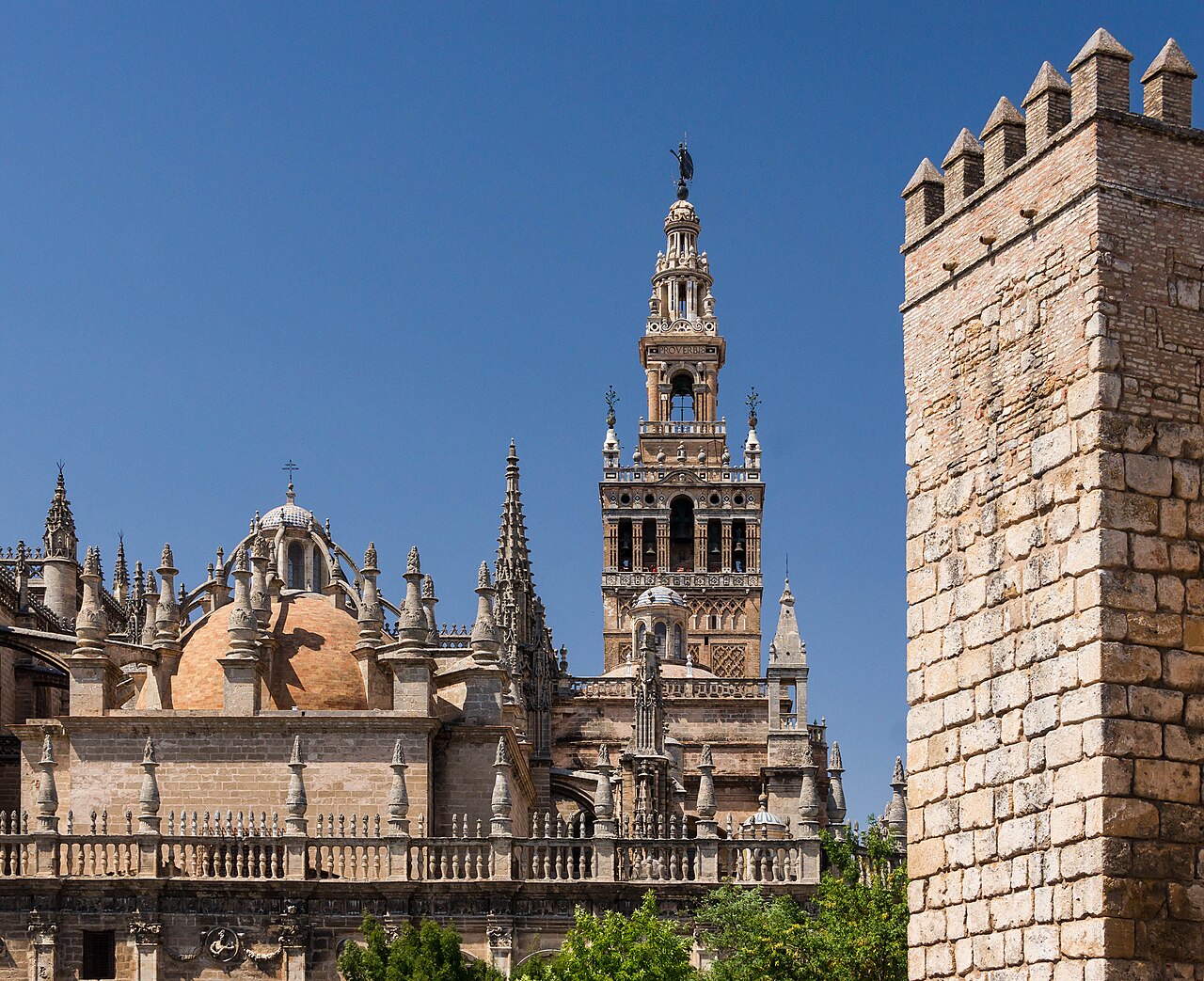
The bell tower was built as a minaret between 1184 and 1198, and when the Christians took the city they kept it and added a belfry on top in the 1560s. Inside there are no stairs for most of the climb, but 35 shallow ramps, wide enough that the muezzin could ride a horse up.
It is 104 metres to the weathervane, and the ramps make it far easier than the height suggests.
The cathedral below is the largest Gothic church in the world by volume, built after 1401 on the footprint of the mosque, and the chapter is said to have resolved to build something so grand that later generations would think them mad. Columbus is buried in it, carried by four figures representing the kingdoms of Spain, and DNA testing in 2006 confirmed at least some of the remains are his.
The orange trees in the courtyard outside are the mosque’s original ablutions court, still on the same grid.
The Alcázar
Pedro I of Castile rebuilt the palace from 1364 and hired Muslim craftsmen from Granada and Toledo to do it, which is why a Christian king’s residence is covered in Arabic inscriptions praising a sultan. The style has a name, Mudéjar, and this is the best surviving example of it.
The royal family still uses the upper floor when they are in Seville, which makes it the oldest royal palace in Europe still in use.
Book online and take an early slot. Daily numbers are capped, the good times sell out days ahead in spring, and the queue for same-day tickets starts before opening.
The gardens run to seven hectares and contain a maze, a pavilion from 1546 and an underground bath complex fed by rainwater. Give them as long as the rooms.
Flamenco, and what is real
Flamenco is Andalusian, it comes largely from the Roma communities of Seville, Jerez and Cádiz, and UNESCO listed it in 2010. The tourist version is a dinner show with a fixed set. The other version is a tablao or a peña, a small room, no meal, one guitar, one singer, one dancer, and it is not comfortable listening at first because the singing is meant to sound raw.
Triana, across the river, was where the Roma quarter and the ceramics workshops were, and the neighbourhood still supplies most of the city’s dancers.
Casa de la Memoria in the centre runs two or three hour-long performances a night in a courtyard for 25 euros, checked in September 2026, with no food and 85 seats.
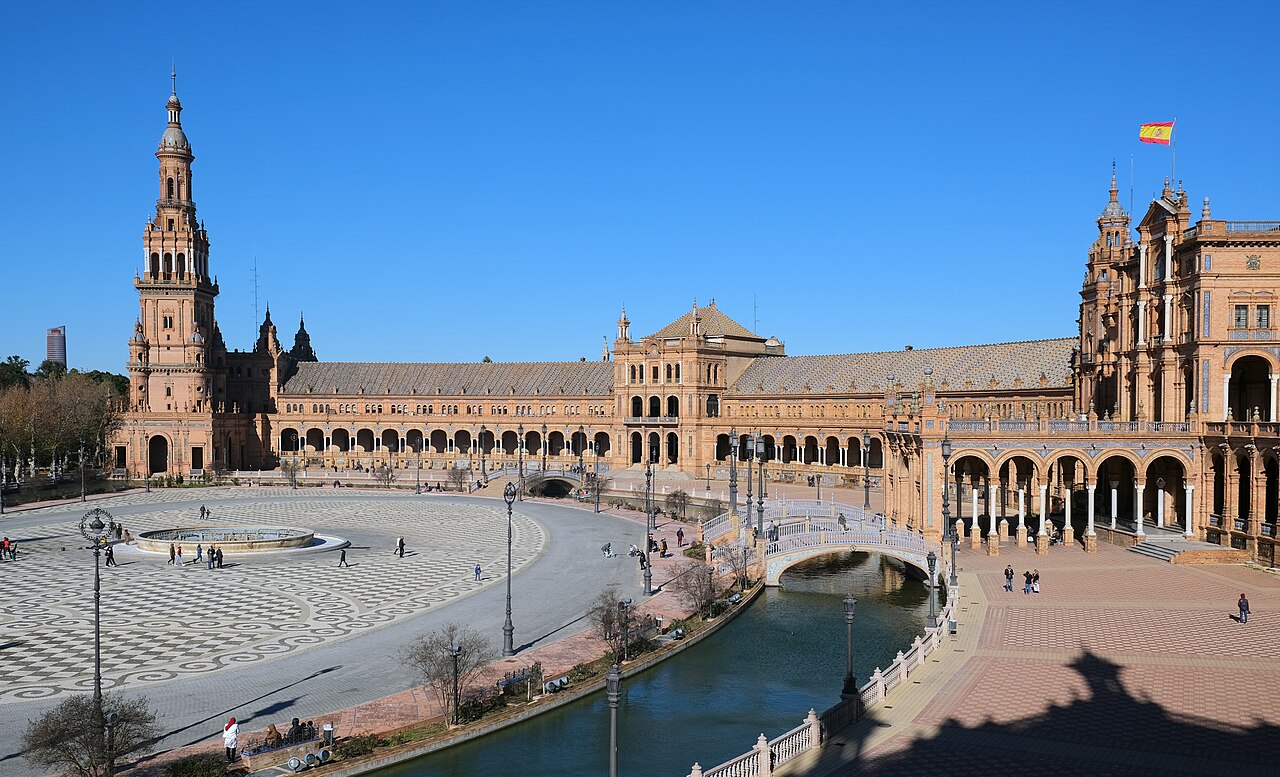
Plaza de España
Built for the 1929 Ibero-American Exposition, a semicircle 200 metres across with a canal, four bridges and 48 tiled alcoves, one for each Spanish province, each with a map and a historical scene. People look for their own province and photograph it.
It stood in for the palace city of Naboo in Attack of the Clones, which is why it occasionally feels like a set.
The park it sits in, María Luisa, is the shady option in the afternoon and the only sensible place in Seville between two and five.
Semana Santa and the Feria
Two weeks in spring turn the city into something else entirely, and if your dates fall on either one you need to know before booking rather than after.
Holy Week runs from Palm Sunday to Easter, when about sixty brotherhoods carry heavy float platforms through the streets on the shoulders of men underneath them, some processions taking twelve hours to reach the cathedral and return. The pointed hoods have nothing to do with anything American; they are penitential and date from the sixteenth century. Streets close without much notice and crossing the centre can take an hour.
The Feria de Abril follows two weeks later: a temporary city of striped tents on the far side of the river, horses, dresses, sherry and dancing until dawn for six nights. Most of the tents are private and belong to families or clubs, which visitors often work out only at the entrance.
The mushroom-shaped wooden structure in Plaza de la Encarnación, Setas de Sevilla, finished in 2011 and one of the largest timber structures anywhere, has a walkway across the top and Roman ruins in the basement, found when they dug the foundations.
Tapas, the local way
A tapa in Seville is a small plate you order at the bar, standing, and then move on. The point is to have two or three in one place and then walk to the next, and a sit-down table for the whole evening misses it.
Order espinacas con garbanzos, spinach with chickpeas and cumin, which is Moorish and older than the Christian city. Solomillo al whisky is pork loin in garlic and whisky, invented in the 1970s and everywhere now. Cola de toro is oxtail stew and it is heavy.
Fino and manzanilla, the dry sherries, come from Jerez and Sanlúcar an hour away, are served cold in a small glass, and go with all of it. They are not sweet, whatever a supermarket sherry has led you to expect.
The AVE runs north to Madrid in two and a half hours. Going west into Portugal is slower than the map suggests, and Porto is usually a flight rather than a train.
Book the trip you have just read about
These are the companies we use ourselves, and what each one is actually good at.
| Provider | Best for | Go to provider |
|---|---|---|

|
Hotels & apartments The widest choice of places to sleep, and the Genius discount starts on booking number one. Read our Booking.com review | Check hotel prices at Booking.com |

|
Flights Live fares from airlines and booking sites side by side, one-click booking, and a refund guarantee you can add to any ticket. Read our Soar review | Check flight prices at Soar |

|
Whole homes A front door of your own, with a kitchen and a washing machine, for a weekend or a month. Read our Airbnb review | Check homes at Airbnb |

|
Luxury hotel perks Breakfast for two and a 4pm checkout at more than 1,900 hotels — if you hold the card. Read our American Express Travel review | See the hotels at American Express Travel |

|
Flight + hotel packages Flight, hotel and car in one basket, on one bill, with one rewards balance across three brands. Read our Expedia Group review | Check package prices at Expedia Group |

|
All-inclusive holidays Plane, hotel, transfer and excursions under one contract, with one number to call when it goes wrong. Read our TUI Group review | Check holiday prices at TUI Group |

|
Small-group tours Groups capped at around twelve, led by somebody who lives in the country you are walking through. Read our Intrepid Travel review | Check tour prices at Intrepid Travel |

|
Tailor-made itineraries A route drawn for you alone, by a company that has been drawing them since 1758. Read our Cox & Kings review | Request a quote at Cox & Kings |

|
Reviews & things to do Check what other travellers actually found, before the money leaves your account. Read our Tripadvisor review | Read the reviews at Tripadvisor |