Start with the money, because it changes how you plan. A pint in a central Oslo bar runs 100 to 130 kroner, roughly 9 to 11 euros, checked in September 2026, and a restaurant main is 250 to 380. Norwegians deal with this the way visitors should: they buy beer at the supermarket before eight in the evening, when the sale of it stops by law, and they drink it before going out.
What that buys, in return, is a city where the expensive things are mostly optional. The opera house roof, the sculpture park, the harbour promenade, the forest at the end of the metro line and the islands in the fjord are all either free or covered by an ordinary transport ticket, and they are the parts worth the trip.
The opera house roof

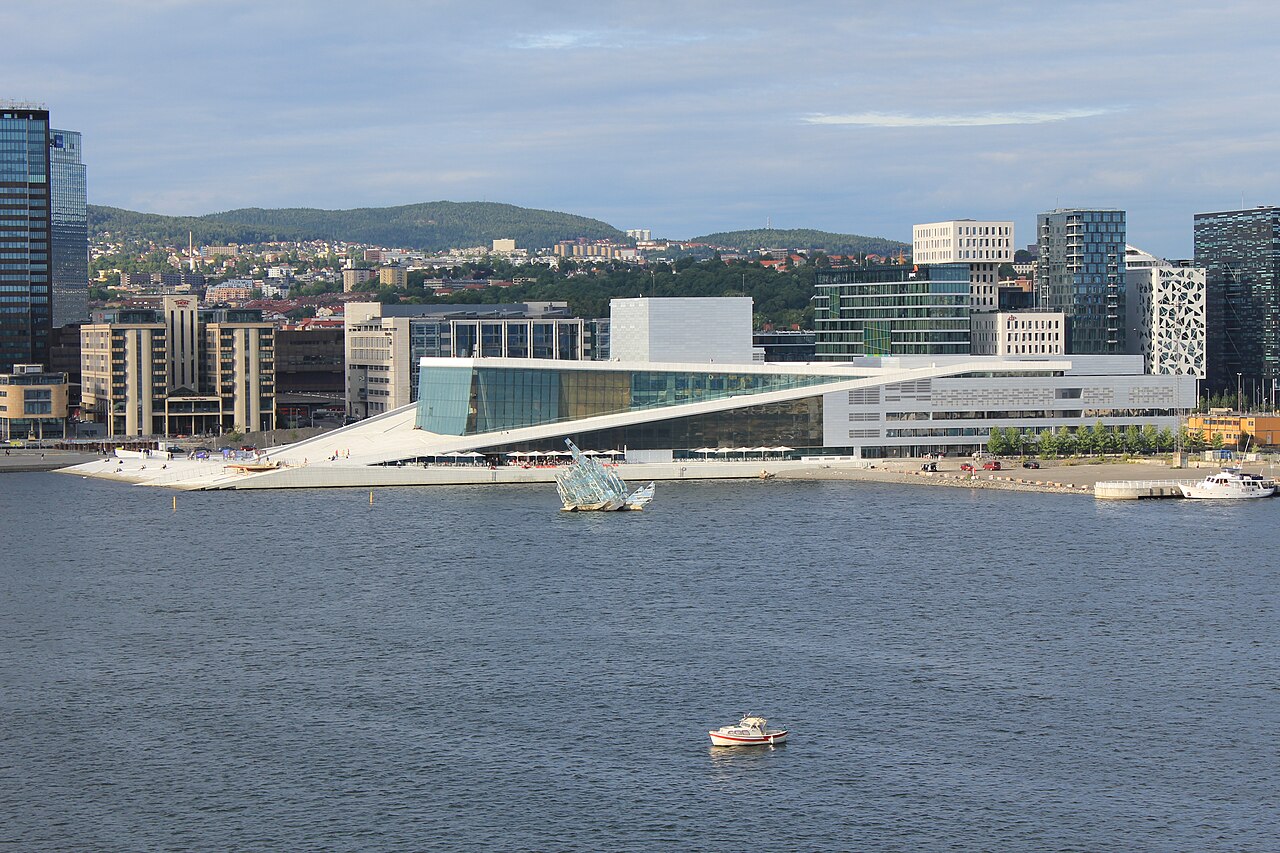
The building opened in 2008 with a roof that slopes from the waterline up to 30 metres, clad in Italian white marble, and it is designed to be walked on. There is no ticket and no closing time. People sit on it with beer at midnight in June, when the sky does not go properly dark.
The marble is cut in a pattern by three artists so that it is not slippery, and it is at its best in rain, when the whole slope goes silver.
In the water in front there is a floating sculpture of glass and steel called She Lies, which turns with the tide and the wind, so its angle is different every time you look at it.
The ships
Two museums on the Bygdøy peninsula hold the most remarkable objects in Norway, and they are twenty minutes from the centre by bus or by the little ferry from the city hall pier.
The Viking Ship Museum has the Oseberg ship, built around 820 and buried in 834 with two women and a great many possessions, dug out of a clay mound in 1904 with about 90 per cent of its timber intact. The carving on the prow is unbroken interlacing animals. Note that the museum is closed for a full rebuild and is due to reopen as the Museum of the Viking Age in 2027, so check before planning a day around it.
The Fram Museum, which is open, holds the whole ship indoors and lets you climb through it. The Fram was built in 1892 with a rounded hull so that pack ice would squeeze her upward instead of crushing her, drifted frozen across the Arctic for three years, and later carried Amundsen south for the run to the pole in 1911. She has been further north and further south than any other wooden ship.
The Kon-Tiki Museum next door has the balsa raft that Thor Heyerdahl sailed 6,900 kilometres across the Pacific in 1947 to prove a theory that turned out to be wrong.
Vigeland
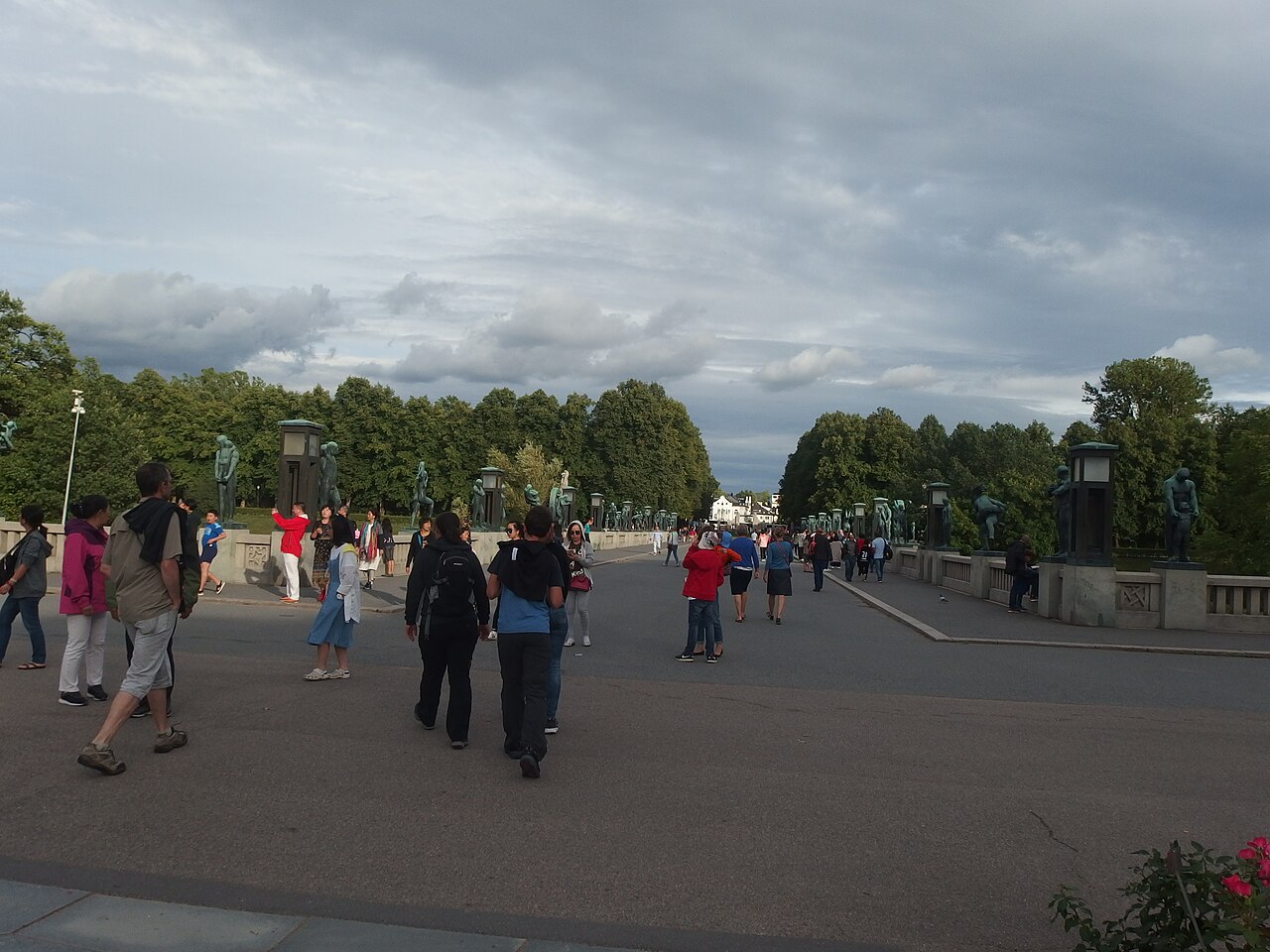
Gustav Vigeland spent from 1924 to 1943 filling Frogner Park with 212 sculptures in bronze, granite and wrought iron, all of them human figures, all of them naked, none of them representing anyone in particular. He designed the layout too, down to the gates.
The park is free and open at all hours. It is a public park that people cross on the way to work.
The centrepiece is a monolith of 121 intertwined figures cut from a single block of granite, 14 metres high, which took three stonemasons fourteen years. The most photographed figure is a small bronze of a furious toddler mid-tantrum, and the reason his left hand is polished bright is that everybody grabs it.
Munch, and the four Screams
There are four versions of The Scream, two paintings and two pastels, and three of them are in Oslo. The National Museum has the 1893 painting. The Munch Museum, in a 13-storey tower on the waterfront since 2021, has the other two and rotates them, showing one at a time in a dark room because the pastels fade.
Two of them have been stolen, in 1994 and 2004, and both were recovered.
Munch left the city about 1,100 paintings and 18,000 prints in his will, so the museum is not a highlights display but very nearly everything he ever made.
Eating on a budget that survives it
Mathallen, a covered food hall in a former factory by the Akerselva river, is where to eat without booking. Around thirty stalls, brown cheese and cured lamb and shrimp sandwiches, and prices that are Oslo prices but at least visible before you commit.
The river walk itself runs eight kilometres from the fjord up through the old industrial district, past waterfalls and mills and a good deal of street art, and it is the best free hour in the city on a dry day.
Brown cheese, brunost, is caramelised whey rather than cheese in any usual sense, sliced thin with a cheese slicer that Norwegians invented in 1925, eaten on waffles. It is sweet and it divides people sharply on first taste.
A pølse, a hot dog wrapped in a potato flatbread with dried onion and shrimp salad, is sold at every kiosk and is what Norway eats at two in the morning.
Getting out of the city without leaving it
Metro line 1 runs from the centre up to Frognerseteren at 469 metres in about half an hour, on an ordinary ticket, and puts you in forest. From there the Holmenkollen ski jump, rebuilt in steel in 2010 and visible from most of the city, is a stop back down the line, with a lift to the top of the tower.
The other direction is the fjord. The public ferries to the islands, Hovedøya and Gressholmen among them, run on the same transport ticket and take twenty minutes, and in summer the beaches on them are where Oslo goes.
The train to Stockholm takes five hours and spends most of them in forest. Reykjavik is three hours west by air and a good deal stranger.
Book the trip you have just read about
These are the companies we use ourselves, and what each one is actually good at.
| Provider | Best for | Go to provider |
|---|---|---|

|
Hotels & apartments The widest choice of places to sleep, and the Genius discount starts on booking number one. Read our Booking.com review | Check hotel prices at Booking.com |

|
Flights Live fares from airlines and booking sites side by side, one-click booking, and a refund guarantee you can add to any ticket. Read our Soar review | Check flight prices at Soar |

|
Whole homes A front door of your own, with a kitchen and a washing machine, for a weekend or a month. Read our Airbnb review | Check homes at Airbnb |

|
Luxury hotel perks Breakfast for two and a 4pm checkout at more than 1,900 hotels — if you hold the card. Read our American Express Travel review | See the hotels at American Express Travel |

|
Flight + hotel packages Flight, hotel and car in one basket, on one bill, with one rewards balance across three brands. Read our Expedia Group review | Check package prices at Expedia Group |

|
All-inclusive holidays Plane, hotel, transfer and excursions under one contract, with one number to call when it goes wrong. Read our TUI Group review | Check holiday prices at TUI Group |

|
Small-group tours Groups capped at around twelve, led by somebody who lives in the country you are walking through. Read our Intrepid Travel review | Check tour prices at Intrepid Travel |
|
Tailor-made itineraries A route drawn for you alone, by a company that has been drawing them since 1758. Read our Cox & Kings review | Request a quote at Cox & Kings |

|
Reviews & things to do Check what other travellers actually found, before the money leaves your account. Read our Tripadvisor review | Read the reviews at Tripadvisor |