Every hour, from the taller tower of St Mary’s Basilica, a trumpeter plays a short melody in each of the four compass directions and stops abruptly in the middle of a phrase. The break commemorates a bugler who, according to the story, was shot through the throat by a Mongol arrow while sounding the alarm in 1241. The bugler is real and on duty, the tower is manned around the clock, and the tradition has been broadcast live on Polish national radio at noon since 1927.
It takes ninety seconds and it is the best free thing in the city. Stand in the square, look up at the left-hand tower, and listen for the cut-off.
The main square

The Rynek Główny was laid out in 1257 on a grid that has not changed since, and at roughly 200 metres square it is one of the largest medieval squares in Europe.
The Cloth Hall down the middle has been a covered market for 700 years and is now stalls selling amber and carved boxes, which is honest enough given that it was always a place for selling things to visitors. Above it, on the first floor, is a gallery of nineteenth-century Polish painting that almost nobody goes into.
Under the square there is a museum four metres down, opened in 2010, built around the excavated foundations, medieval drains and coin scales found during roadworks. It is called Rynek Underground, it is air-conditioned, and it is the answer to a hot afternoon or a wet one.
Inside St Mary’s, the wooden altarpiece by Veit Stoss took twelve years to carve and was finished in 1489. It is opened daily at a fixed hour with some ceremony. The Germans dismantled and removed it in 1939; it came back in 1946.
Wawel
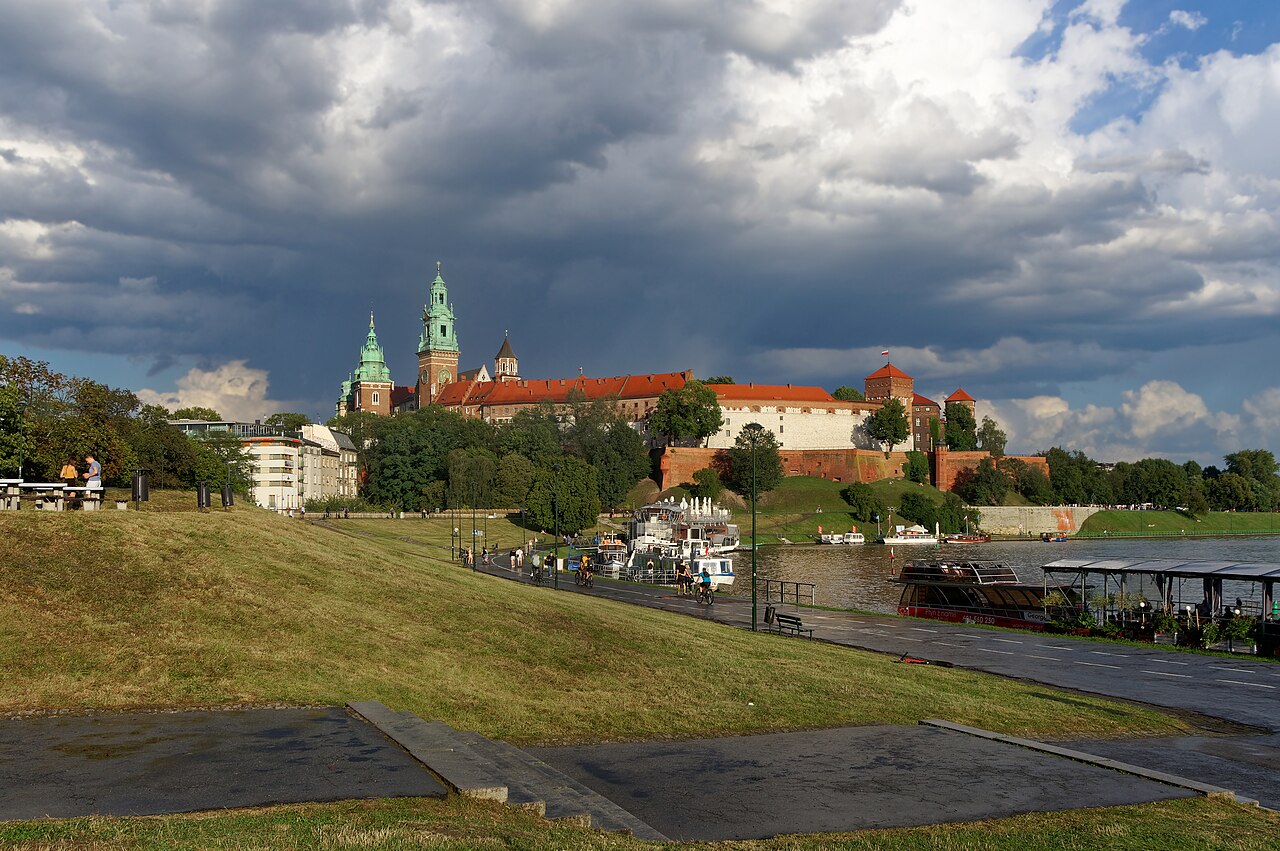
The castle and cathedral sit on a limestone rise at the southern edge of the old town, and Polish kings were crowned and buried in the cathedral for four centuries.
Wawel is sold as separate tickets for separate parts, with fixed entry times, and the numbers per day are capped. Decide before arriving which two you want rather than working it out at the counter with a queue behind you.
The state rooms hold a set of 136 Flemish tapestries commissioned in the 1550s, out of an original 350. They were shipped to Canada in 1939 to keep them from the Germans and did not come home until 1961, after a long argument between Ottawa and Warsaw.
At the base of the hill there is a bronze dragon that breathes real fire every few minutes, run on a gas line, and it is aimed at children and entirely successful with them.
Kazimierz
Kazimierz was a separate town until 1800 and the centre of Jewish life in Krakow for five hundred years. About 68,000 Jews lived in the city in 1939, and a few hundred remained after 1945.
Seven synagogues survive within a few streets, more than in any other city in Poland. The Remuh, from 1558, is still in use for services, and its cemetery next door has stones from the sixteenth century that were buried during the war and dug up afterwards.
The district was derelict until the 1990s and is now where the bars are, which sits awkwardly and is acknowledged locally as sitting awkwardly. Both things are true of the same streets at the same time.
Eat a zapiekanka at the round market building in Plac Nowy: half a baguette with mushrooms and cheese under a grill, sold until very late, about 20 złoty in September 2026.
What to eat, and the milk bars
A bar mleczny is a canteen subsidised by the state since the 1960s, serving Polish home food at prices that have not caught up with the rest of the city. You read a board, pay at a till, take a ticket to a hatch. Some have been redecorated and some have not changed since 1974.
Pierogi come boiled or fried, and the fillings worth ordering are ruskie, which is potato and curd cheese and has nothing to do with Russia, and the meat ones with fried onion on top.
Żurek is a sour soup made from fermented rye flour, served with sausage and half a boiled egg, sometimes in a bread bowl, and it is better than that description makes it sound. Bigos is cabbage and meat stewed for days and improved each time it is reheated.
Vodka here is drunk cold, neat, in one, with food, and never mixed. Ordering it with a soft drink in a traditional place gets you a look.
Auschwitz and the salt mine
Both are day trips and neither fits alongside the other. Auschwitz-Birkenau is 70 kilometres west, about ninety minutes by bus, entry is free but requires a booked time slot, and between April and October a guided tour is compulsory for most of the day. Give it the whole day and do not schedule anything after it.
Wieliczka salt mine is 15 kilometres out and worked continuously from the thirteenth century until 1996. The tourist route runs about 3.5 kilometres and 135 metres down, through chambers carved out of rock salt by miners in their own time, including a chapel with chandeliers of salt crystal and a relief of the Last Supper cut into a wall.
There are 800 steps down at the start. There is a lift at the end, in a cage that takes nine people and moves quickly.
The overnight and early trains run north to Warsaw in under three hours, and west to Prague in about seven, which is why Krakow so often turns up in the middle of a longer rail trip across Europe.
Book the trip you have just read about
These are the companies we use ourselves, and what each one is actually good at.
| Provider | Best for | Go to provider |
|---|---|---|

|
Hotels & apartments The widest choice of places to sleep, and the Genius discount starts on booking number one. Read our Booking.com review | Check hotel prices at Booking.com |

|
Flights Live fares from airlines and booking sites side by side, one-click booking, and a refund guarantee you can add to any ticket. Read our Soar review | Check flight prices at Soar |

|
Whole homes A front door of your own, with a kitchen and a washing machine, for a weekend or a month. Read our Airbnb review | Check homes at Airbnb |

|
Luxury hotel perks Breakfast for two and a 4pm checkout at more than 1,900 hotels — if you hold the card. Read our American Express Travel review | See the hotels at American Express Travel |

|
Flight + hotel packages Flight, hotel and car in one basket, on one bill, with one rewards balance across three brands. Read our Expedia Group review | Check package prices at Expedia Group |

|
All-inclusive holidays Plane, hotel, transfer and excursions under one contract, with one number to call when it goes wrong. Read our TUI Group review | Check holiday prices at TUI Group |

|
Small-group tours Groups capped at around twelve, led by somebody who lives in the country you are walking through. Read our Intrepid Travel review | Check tour prices at Intrepid Travel |

|
Tailor-made itineraries A route drawn for you alone, by a company that has been drawing them since 1758. Read our Cox & Kings review | Request a quote at Cox & Kings |

|
Reviews & things to do Check what other travellers actually found, before the money leaves your account. Read our Tripadvisor review | Read the reviews at Tripadvisor |