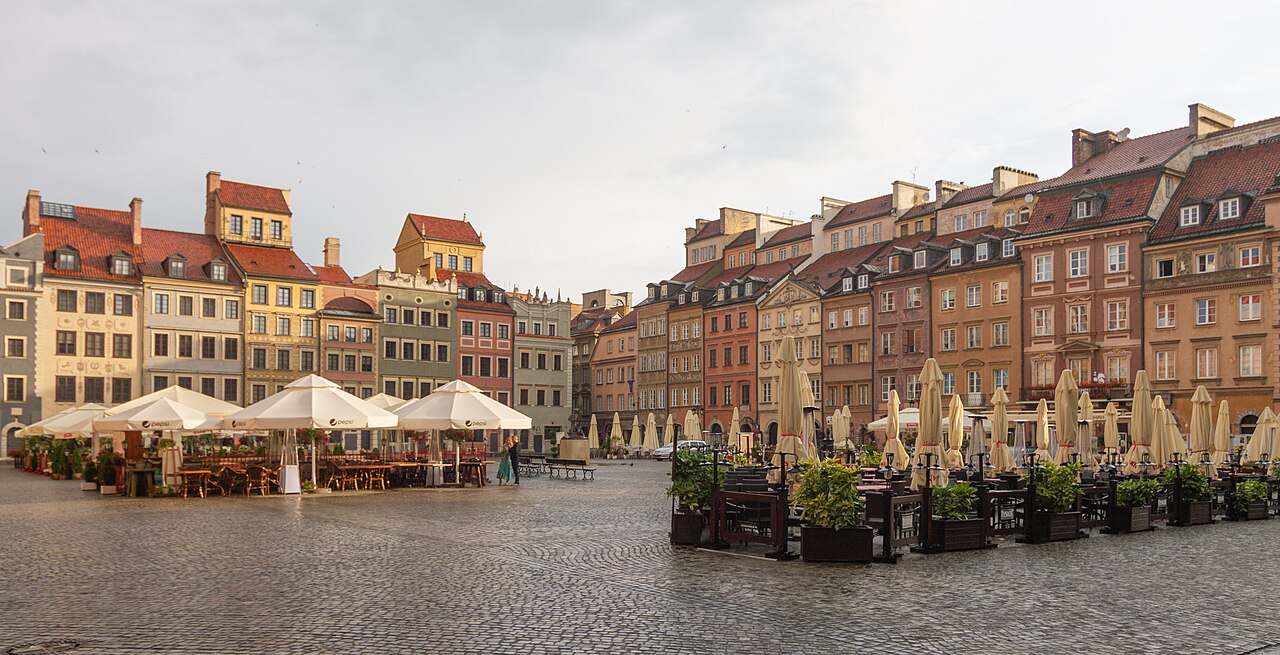
The old town of Warsaw was finished in 1962. Not restored, not repaired. Rebuilt from nothing, on ground that had been cleared to rubble, using eighteenth-century townscape paintings by Bernardo Bellotto as the reference for facade details nobody could remember.
UNESCO listed it in 1980, and it was a controversial listing precisely because everything on the square is younger than most of the people who queue there. The committee’s reasoning was that the reconstruction itself was the heritage.
What happened
The Warsaw Uprising began on 1 August 1944 and lasted 63 days. When it ended, Hitler ordered the city razed. German demolition units worked through the winter with flamethrowers and explosives, building by building, on a plan, targeting archives and libraries and monuments in particular.
By January 1945 roughly 85 per cent of the left-bank city was gone and about 700,000 of the city’s inhabitants were dead across the whole war, more than Britain and the United States lost combined.
The Warsaw Rising Museum, in a former tram power station, covers the 63 days hour by hour with recordings, printing presses, a reconstructed sewer you can crawl through, and the wall of names. It is busy and it is not a light hour. Free on Thursdays, closed on Tuesdays.
Chopin
He was born 46 kilometres west in 1810, left Poland at twenty and never came back. His heart did: sealed in a jar of alcohol, smuggled past Russian customs by his sister, and walled into a pillar of the Holy Cross Church on Krakowskie Przedmieście, where it still is, with a plaque.
From mid-May to the end of September there are free piano concerts in Łazienki Park on Sunday afternoons, under a monument of Chopin sitting beneath a windswept willow. People bring blankets and sit on the grass. The original monument was blown up by the Germans in 1940 and recast in 1958.
The Chopin Museum on Okólnik is a modern interactive one in a seventeenth-century palace, with the last piano he played in Paris.
The Palace of Culture
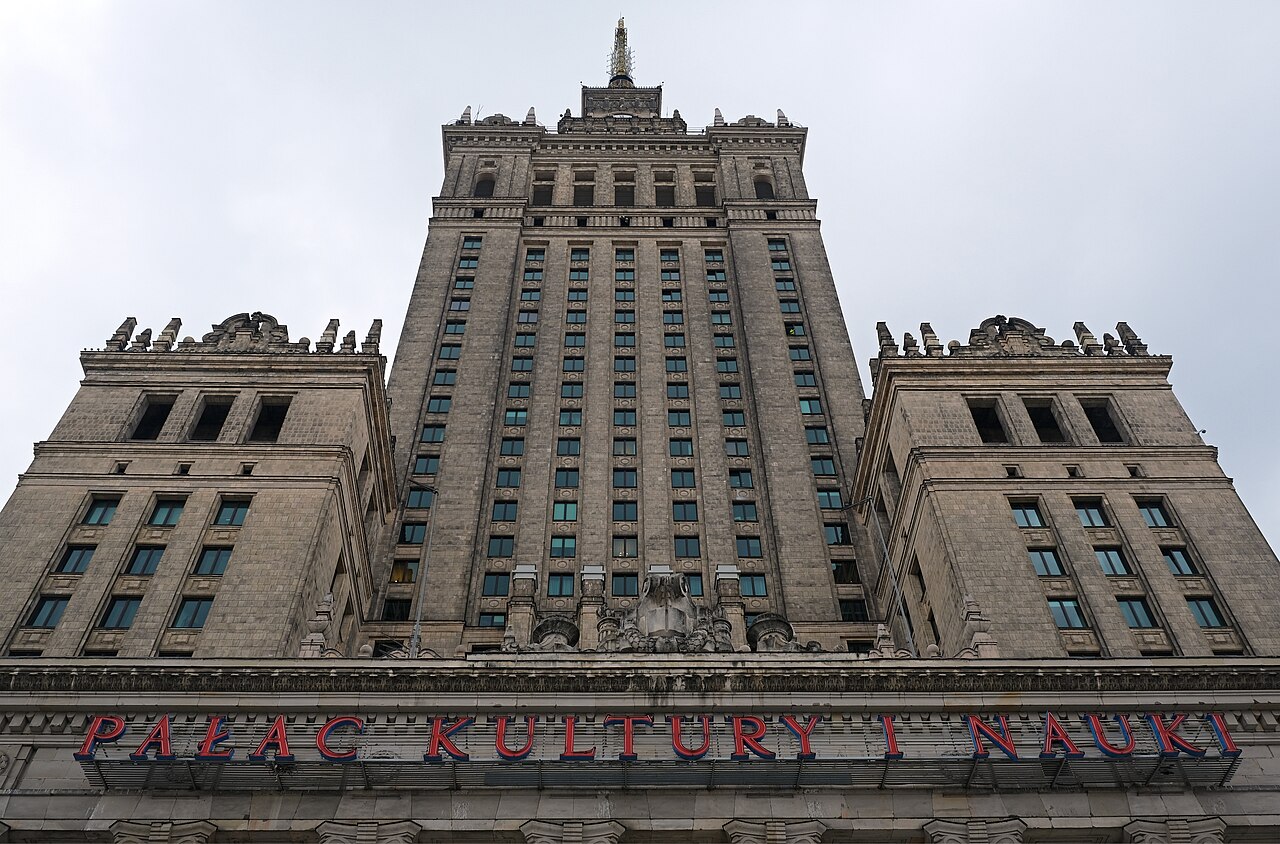
Stalin gave it to Poland in 1952, built by Soviet workers, finished in 1955, 237 metres to the tip of the spire, and still the tallest building in the country. Poles have never agreed about it. A common joke holds that the best view in Warsaw is from the terrace on the thirtieth floor, because it is the only place you cannot see the building itself.
Proposals to demolish it come round every decade and never happen, partly because it is now a listed monument and partly because it contains four theatres, two cinemas, a swimming pool and a museum.
The viewing terrace on floor 30 is at 114 metres, open into the evening, and the ticket is 25 złoty as checked in September 2026. The glass tower blocks that have grown up around it since 2000 now compete with it, which is a change since about 2015.
The ghetto
From November 1940 the Germans sealed about 400,000 people into an area of 3.4 square kilometres behind a wall. Most were deported to Treblinka in the summer of 1942. The ghetto uprising of April 1943 was a separate event from the 1944 rising, fought by a few hundred people with almost no weapons, and it ended with the whole district levelled.
Almost nothing physical survives. The line of the wall is marked in the pavement with a cast-iron strip running through ordinary streets, and two short fragments of the original brick wall stand in courtyards off Sienna and Złota streets, reachable through an unmarked gate.
POLIN, the Museum of the History of Polish Jews, opened in 2014 on the site and deliberately covers the thousand years before the war rather than only the destruction. It takes three hours.
Eating
Warsaw is cheaper than Berlin and considerably better fed than its reputation suggests. Milk bars, the state-subsidised canteens, still operate and still serve a full lunch for under 30 złoty.
Pyzy are potato dumplings the size of a fist, served with fried onion and pork fat. Śledź is herring, cured in oil with onion or in cream with apple, and it is what people order with cold vodka before the food arrives.
Hala Koszyki, a 1909 market hall reopened in 2016, is where the city eats now, and it is loud from about seven onward.
The neon
In the 1960s and 1970s the Polish state commissioned neon signs from graphic artists as a matter of policy, to brighten socialist streets, and hundreds went up over shops and cinemas. After 1989 they came down almost as fast, replaced by plastic advertising.
The Neon Muzeum in Praga collects the survivors in a warehouse and switches them on. It is a small museum, an hour at most, and it is one of the few places that shows what the city looked like to the people who lived in it rather than to the people who fought over it.
Praga, across the river
The right bank was taken by the Red Army in September 1944 and sat there while the left bank burned, which is why its pre-war buildings are still standing with the bullet holes in them. It was rough for decades, is now filling up with studios and bars, and it holds the only surviving pre-war courtyard shrines, small Madonnas in wooden cases put up by residents during the occupation.
For the other Polish city, Krakow is under three hours south and survived the war intact, which makes the contrast between the two worth doing in one trip. Berlin is six hours west.
Book the trip you have just read about
These are the companies we use ourselves, and what each one is actually good at.
| Provider | Best for | Go to provider |
|---|---|---|

|
Hotels & apartments The widest choice of places to sleep, and the Genius discount starts on booking number one. Read our Booking.com review | Check hotel prices at Booking.com |

|
Flights Live fares from airlines and booking sites side by side, one-click booking, and a refund guarantee you can add to any ticket. Read our Soar review | Check flight prices at Soar |

|
Whole homes A front door of your own, with a kitchen and a washing machine, for a weekend or a month. Read our Airbnb review | Check homes at Airbnb |

|
Luxury hotel perks Breakfast for two and a 4pm checkout at more than 1,900 hotels — if you hold the card. Read our American Express Travel review | See the hotels at American Express Travel |

|
Flight + hotel packages Flight, hotel and car in one basket, on one bill, with one rewards balance across three brands. Read our Expedia Group review | Check package prices at Expedia Group |

|
All-inclusive holidays Plane, hotel, transfer and excursions under one contract, with one number to call when it goes wrong. Read our TUI Group review | Check holiday prices at TUI Group |

|
Small-group tours Groups capped at around twelve, led by somebody who lives in the country you are walking through. Read our Intrepid Travel review | Check tour prices at Intrepid Travel |

|
Tailor-made itineraries A route drawn for you alone, by a company that has been drawing them since 1758. Read our Cox & Kings review | Request a quote at Cox & Kings |

|
Reviews & things to do Check what other travellers actually found, before the money leaves your account. Read our Tripadvisor review | Read the reviews at Tripadvisor |