Manneken Pis is 61 centimetres tall, stands behind a railing on a street corner, and has a wardrobe of over a thousand costumes kept in a museum around the corner, which the city changes on him about 130 times a year according to a published calendar. That is the whole attraction. People arrive expecting something and find a small bronze child at knee height with forty phones pointed at him.
Two minutes’ walk away is one of the best squares in Europe, so the disappointment is short.
The Grand Place
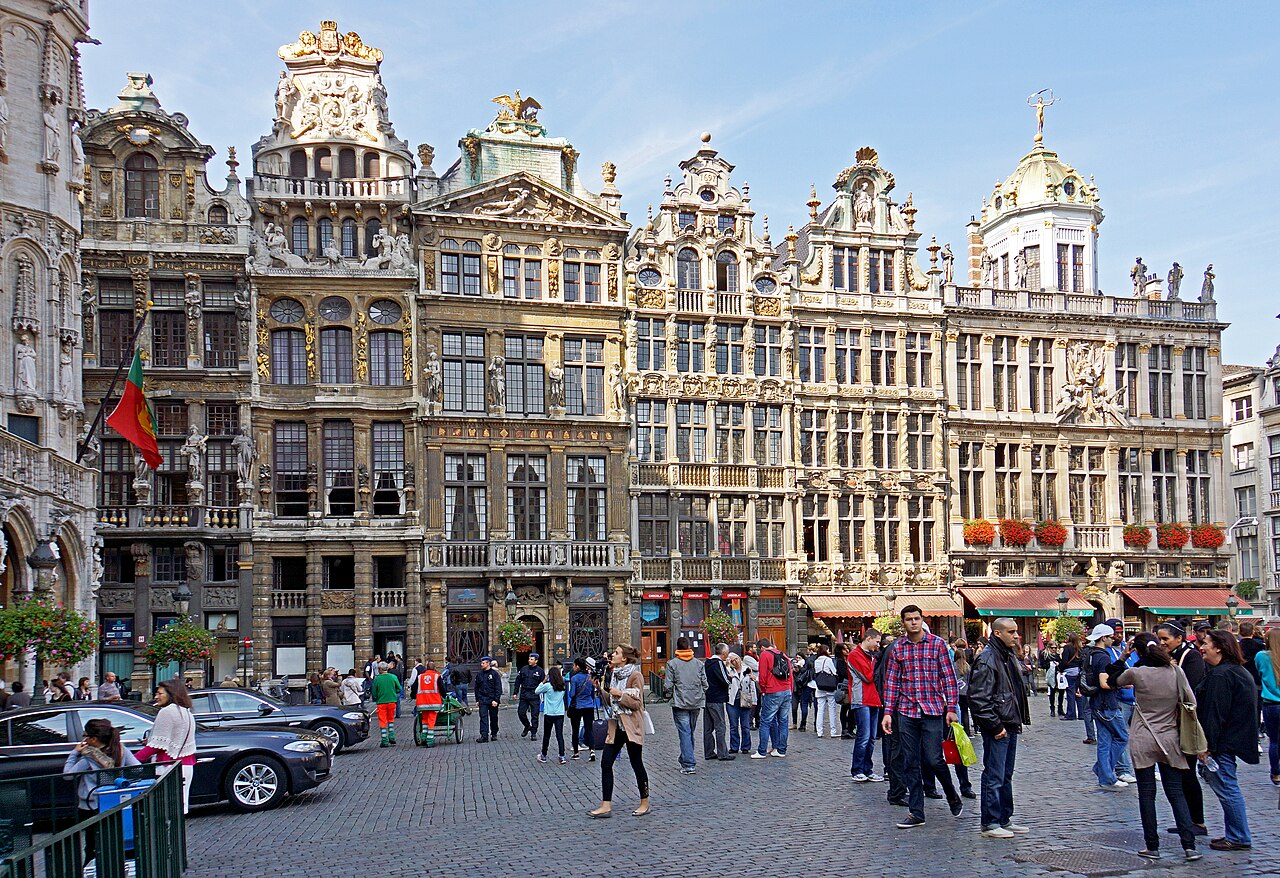
In August 1695 a French army under Marshal de Villeroy shelled Brussels for three days, burning about a third of the city and destroying everything on the square except the town hall tower, which they had used as their aiming point and which therefore survived.
The guilds rebuilt their houses within four years, each one competing with its neighbours, and the result is a single square in a single moment of taste: gold leaf, gables, gilded statues on the rooflines, and a set of house names that read like an inventory. The Fox. The Wheelbarrow. The Bag. The She-Wolf.
Go twice. Once in daylight to read the facades, and once after dark when the floodlighting comes on and the gold does what it was meant to do.
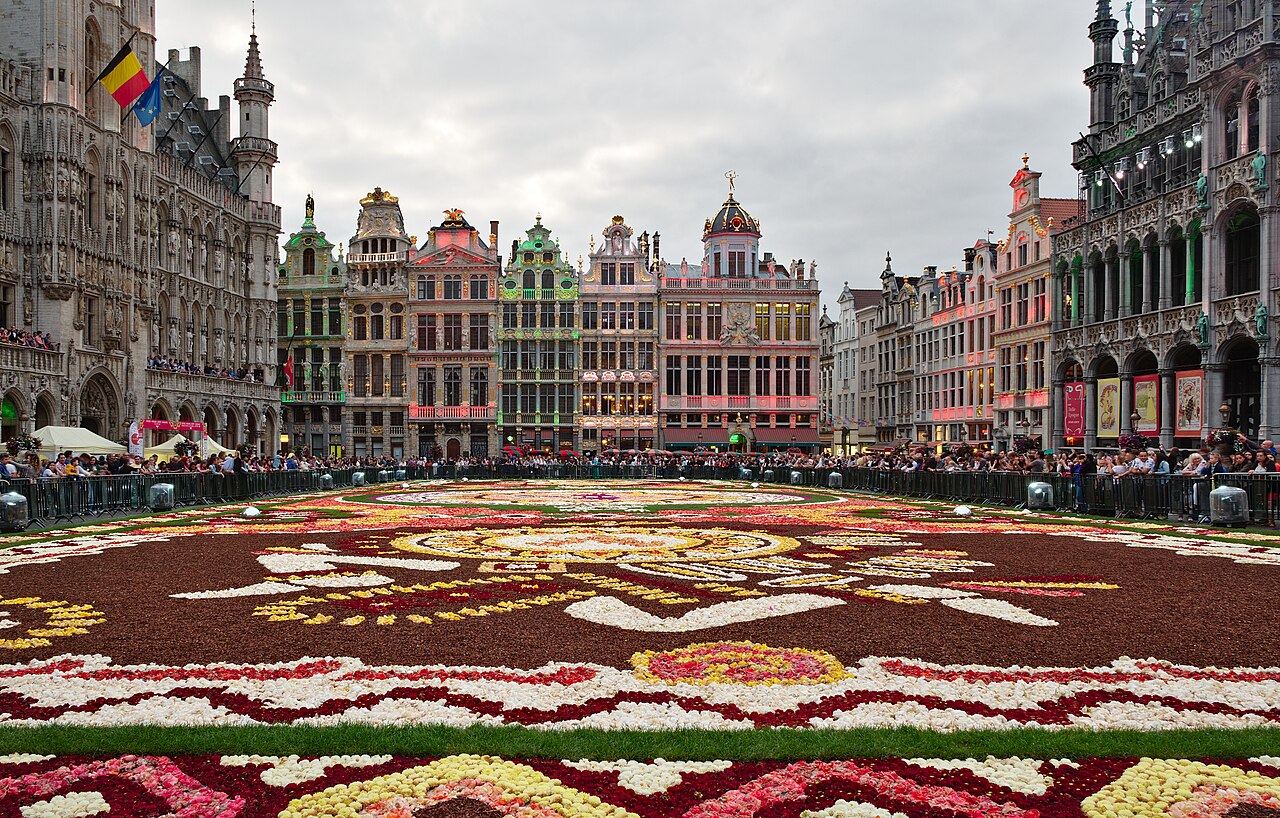
Every two years in August, a carpet of about 750,000 begonias is laid across the square for four days. If your dates land on it, plan the day around it, because it does not come back for another two years.
Chips, and how not to embarrass yourself
They are Belgian. The claim is that American soldiers in the First World War met them in French-speaking Wallonia and named them wrong, and the Belgians have not let it go since.
They are fried twice, once at a lower temperature to cook the potato through and once hot to crisp it, traditionally in beef fat. You buy them from a friterie, a standing kiosk, in a paper cone, and the sauce is the decision: andalouse, samurai, brasil, or plain mayonnaise, which here is thicker and eggier than the supermarket kind.
Ketchup is available and marks you out as a foreigner instantly, which is fine.
The other three things to eat are waffles, mussels and chocolate. Note that there are two waffles: the Brussels waffle, rectangular, light, eaten with a fork; and the Liège waffle, dense and uneven with pearl sugar caramelised into the crust, eaten walking. The one sold from street vans buried under cream and strawberries is a tourist invention and Belgians will tell you so unprompted.
Beer, and the sour ones
Belgium has several hundred breweries and the beer culture is on the UNESCO intangible heritage list, added in 2016. Every beer has its own glass and bars take that seriously.
The style to try here and almost nowhere else is lambic. It is fermented by wild yeast that lives in the air of the Zenne valley around Brussels, in open vats left overnight in winter, and nobody adds anything. Straight lambic is flat and sour. Gueuze is a blend of young and old lambic, refermented in the bottle, sparkling and sharp, and it tastes far more like cider or dry sherry than like beer.
Kriek is lambic with sour cherries, and the traditional versions are dry, not the sweet red syrup sold under the same name.
The Cantillon brewery in Anderlecht, still working since 1900 and run by the same family, opens to visitors as a museum on most weekdays, and the tour is self-guided through a working brewery with cobwebs left in place on purpose because the spiders control the flies.
The comics
Tintin, the Smurfs, Lucky Luke and Spirou are all Belgian, and Belgium published more comics per head than anywhere outside Japan for most of the twentieth century.
Since 1991 the city has been painting them full-size onto blank gable walls, and there are now more than 60 of them scattered through the centre. The route is signposted and free and takes about ninety minutes on foot, and it drags you through ordinary streets you would otherwise never enter.
The Belgian Comic Strip Center is in a 1906 Horta building, an art nouveau department store with an iron and glass hall, and the building is at least half the reason to go in.
The Atomium, and whether to bother
Nine steel spheres 18 metres across, joined by tubes, standing 102 metres high, built for the 1958 world fair and meant to last six months. It is a unit cell of an iron crystal magnified 165 billion times, which was a statement about the atomic age made two years before Belgium lost the Congo.
It is a twenty-minute metro ride from the centre to Heysel, and inside there is an exhibition, escalators through the tubes and a view from the top sphere. Whether it repays half a day depends entirely on how you feel about 1950s optimism rendered in stainless steel.
The European Quarter, on the other hand, is a district of glass office buildings where nothing is open at the weekend, and it repays nobody. The Parliament runs free visits, and unless institutions genuinely interest you, that hour is better spent on the comic walk.
Art nouveau, if you have another hour
Victor Horta built the first art nouveau house here in 1893 and four of his buildings are UNESCO-listed. His own house and studio in Saint-Gilles is now a museum, and no photography is allowed inside, which is annoying and means you actually look at it.
Brussels demolished a great many of these buildings in the 1960s and 1970s, so thoroughly that the practice acquired a name in architecture, brusselisation.
An hour and a half by train each way, Amsterdam north and Paris south.
Book the trip you have just read about
These are the companies we use ourselves, and what each one is actually good at.
| Provider | Best for | Go to provider |
|---|---|---|

|
Hotels & apartments The widest choice of places to sleep, and the Genius discount starts on booking number one. Read our Booking.com review | Check hotel prices at Booking.com |

|
Flights Live fares from airlines and booking sites side by side, one-click booking, and a refund guarantee you can add to any ticket. Read our Soar review | Check flight prices at Soar |

|
Whole homes A front door of your own, with a kitchen and a washing machine, for a weekend or a month. Read our Airbnb review | Check homes at Airbnb |

|
Luxury hotel perks Breakfast for two and a 4pm checkout at more than 1,900 hotels — if you hold the card. Read our American Express Travel review | See the hotels at American Express Travel |

|
Flight + hotel packages Flight, hotel and car in one basket, on one bill, with one rewards balance across three brands. Read our Expedia Group review | Check package prices at Expedia Group |

|
All-inclusive holidays Plane, hotel, transfer and excursions under one contract, with one number to call when it goes wrong. Read our TUI Group review | Check holiday prices at TUI Group |

|
Small-group tours Groups capped at around twelve, led by somebody who lives in the country you are walking through. Read our Intrepid Travel review | Check tour prices at Intrepid Travel |

|
Tailor-made itineraries A route drawn for you alone, by a company that has been drawing them since 1758. Read our Cox & Kings review | Request a quote at Cox & Kings |

|
Reviews & things to do Check what other travellers actually found, before the money leaves your account. Read our Tripadvisor review | Read the reviews at Tripadvisor |