Both of the museums people come to Florence for close on the same day. The Uffizi and the Accademia, which holds the David, are shut on Mondays, along with a good number of smaller collections. A Monday in Florence is still a fine day out, but it is a day of churches, bridges and the dome, and planning it as anything else ends badly.
The dome, and what the climb actually involves
Brunelleschi built the dome between 1420 and 1436 without a supporting timber framework, using a herringbone brick pattern and two shells with a stair between them, and nobody has ever fully explained how he solved the problem. Climbing it means going up that gap: 463 steps, no lift, no way to turn back once the flow starts because the stair is one-way and single file.

People with claustrophobia should not attempt it, and that is not a caution written for liability. The final section is a curved passage between the shells where you walk leaning with the slope of the dome, in a space narrower than your shoulders in places, with people behind you.
Reservation is compulsory, with a fixed time slot, and it books out days ahead.
Halfway up you come out on the walkway inside the drum, at the base of Vasari’s Last Judgement fresco, close enough to see brushwork on a painting 90 metres above the floor. That alone is worth the ticket for a lot of visitors, and it comes before the hard part.
Giotto’s campanile next door has 414 steps, a lift-free climb of similar effort, no confined passages, and the advantage of a view with the dome in it.
The cathedral ticket, which is misunderstood
Entry to the cathedral nave is free and the queue for it moves. Everything else on the square is sold as a single combined pass valid several days: dome, campanile, baptistery, crypt and the Opera del Duomo museum. There is no cheaper way to buy the dome alone.
The museum is the most skipped part and holds the most. Ghiberti’s original Gates of Paradise panels are there, restored over 27 years and kept behind glass in a controlled atmosphere; what is on the baptistery outside is a copy. Donatello’s wooden Magdalene is in the same building, and so is Michelangelo’s unfinished Pietà, which he attacked with a hammer in old age.
Shoulders and knees covered, everywhere on this square.
The Uffizi, in the order that works
The gallery occupies a sixteenth-century office building, which is what uffizi means, built for the Medici administration and converted into a museum in 1765. It is arranged chronologically along two long corridors, and the standard mistake is spending the first hour in rooms of thirteenth-century altarpieces and arriving at Botticelli exhausted.
The Birth of Venus and the Primavera are in rooms 10 to 14, which is early. See them first, walk back, and take the rest in any order.
Timed tickets, booked ahead, and a booking fee that everyone resents. Free entry on the first Sunday of the month applies here as at all Italian state museums, and the queue on that day is measured in hours.
The corridor windows over the Arno are the reason the building sits where it does. Vasari also built a private raised passage from here across the Ponte Vecchio to the Pitti Palace so the Medici could cross the city without touching the street; it reopened to visitors in 2024 after decades closed.
The bridge, and why it smells of nothing
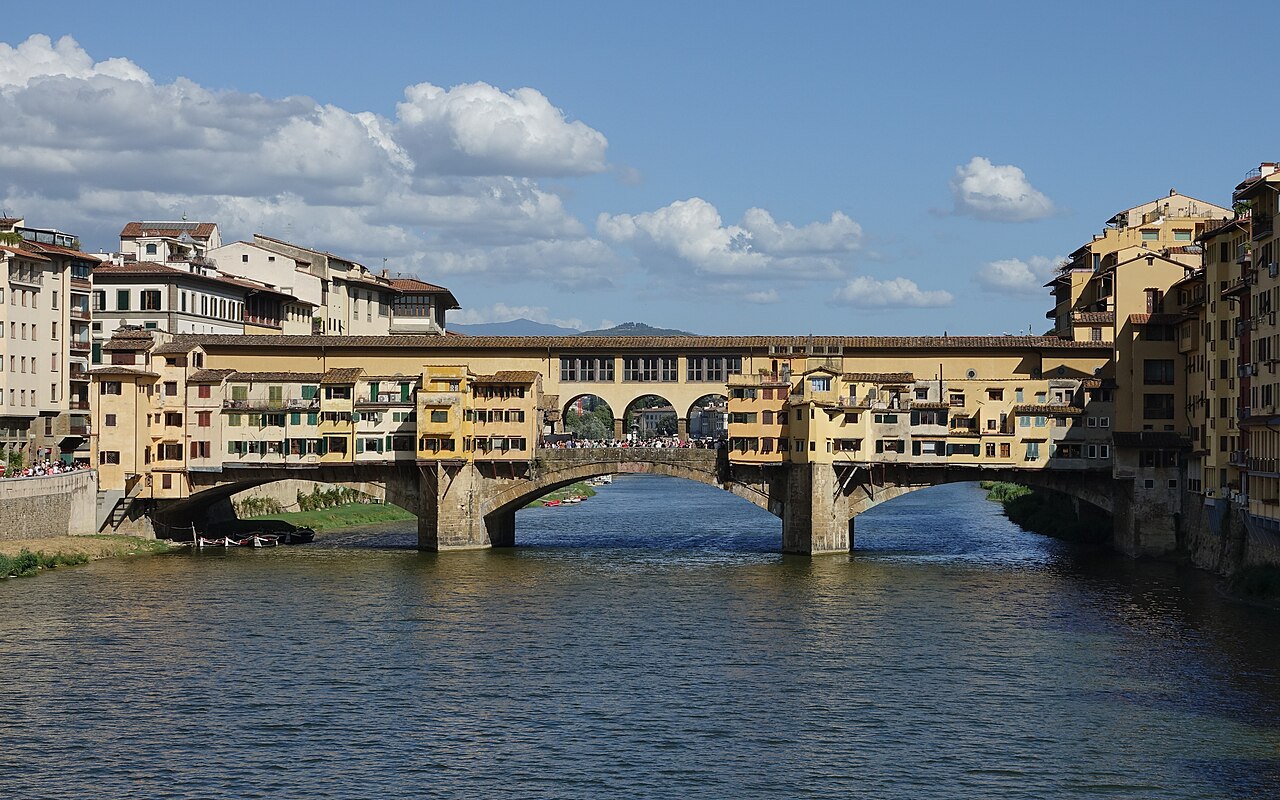
The shops on the Ponte Vecchio were butchers until 1593, when Ferdinando I evicted them and gave the leases to goldsmiths, on the grounds that the smell was reaching the Vasari Corridor above. Jewellers have held the shops ever since, and they still close their fronts with heavy wooden shutters like travelling trunks.
It is the only bridge in Florence that survived the war. The German army destroyed the rest of the Arno crossings in August 1944 and left this one, reportedly on a direct order, blowing up the medieval buildings at either end instead to block the approach.
Go at seven in the morning to see it empty, or stand on the Ponte Santa Trinita downstream to see it whole.
Lunch, and the sandwich queue that is worth it
Florence eats standing up at lunchtime. All’Antico Vinaio on Via dei Neri has a queue down the street for schiacciata sandwiches the size of a forearm; the queue moves fast, they run several counters, and the bread is what makes it. Locals argue about whether it is still good, which is a sign it once was.
The Mercato Centrale has a produce floor downstairs from 1874 and a food hall upstairs from 2014. Downstairs sells tripe, which Florence eats seriously: lampredotto, the fourth stomach of a cow, simmered and served in a bun with green sauce, is the city’s street food and there are carts selling it around the market and at Piazza dei Cimatori.
Bistecca alla fiorentina is a different proposition. It is a T-bone cut at least three fingers thick, cooked rare on the bone, priced by weight, and never for one person; ordering it well done is refused outright in serious places.
Sunset, and the two options
Piazzale Michelangelo is the terrace everyone goes to, up the hill on the south bank, with a bronze copy of the David and a view of the whole city. It is a twenty-minute climb or bus 12 or 13, and it is crowded from an hour before sunset.
Five minutes further up the hill is San Miniato al Monte, a Romanesque church from 1013 with a green and white marble front, a cemetery, and monks who sing Gregorian chant at vespers in the late afternoon. Fewer people, better building, same light.
The train south to Rome takes ninety minutes, and north to Venice just over two hours.
Book the trip you have just read about
These are the companies we use ourselves, and what each one is actually good at.
| Provider | Best for | Go to provider |
|---|---|---|

|
Hotels & apartments The widest choice of places to sleep, and the Genius discount starts on booking number one. Read our Booking.com review | Check hotel prices at Booking.com |

|
Flights Live fares from airlines and booking sites side by side, one-click booking, and a refund guarantee you can add to any ticket. Read our Soar review | Check flight prices at Soar |

|
Whole homes A front door of your own, with a kitchen and a washing machine, for a weekend or a month. Read our Airbnb review | Check homes at Airbnb |

|
Luxury hotel perks Breakfast for two and a 4pm checkout at more than 1,900 hotels — if you hold the card. Read our American Express Travel review | See the hotels at American Express Travel |

|
Flight + hotel packages Flight, hotel and car in one basket, on one bill, with one rewards balance across three brands. Read our Expedia Group review | Check package prices at Expedia Group |

|
All-inclusive holidays Plane, hotel, transfer and excursions under one contract, with one number to call when it goes wrong. Read our TUI Group review | Check holiday prices at TUI Group |

|
Small-group tours Groups capped at around twelve, led by somebody who lives in the country you are walking through. Read our Intrepid Travel review | Check tour prices at Intrepid Travel |

|
Tailor-made itineraries A route drawn for you alone, by a company that has been drawing them since 1758. Read our Cox & Kings review | Request a quote at Cox & Kings |

|
Reviews & things to do Check what other travellers actually found, before the money leaves your account. Read our Tripadvisor review | Read the reviews at Tripadvisor |