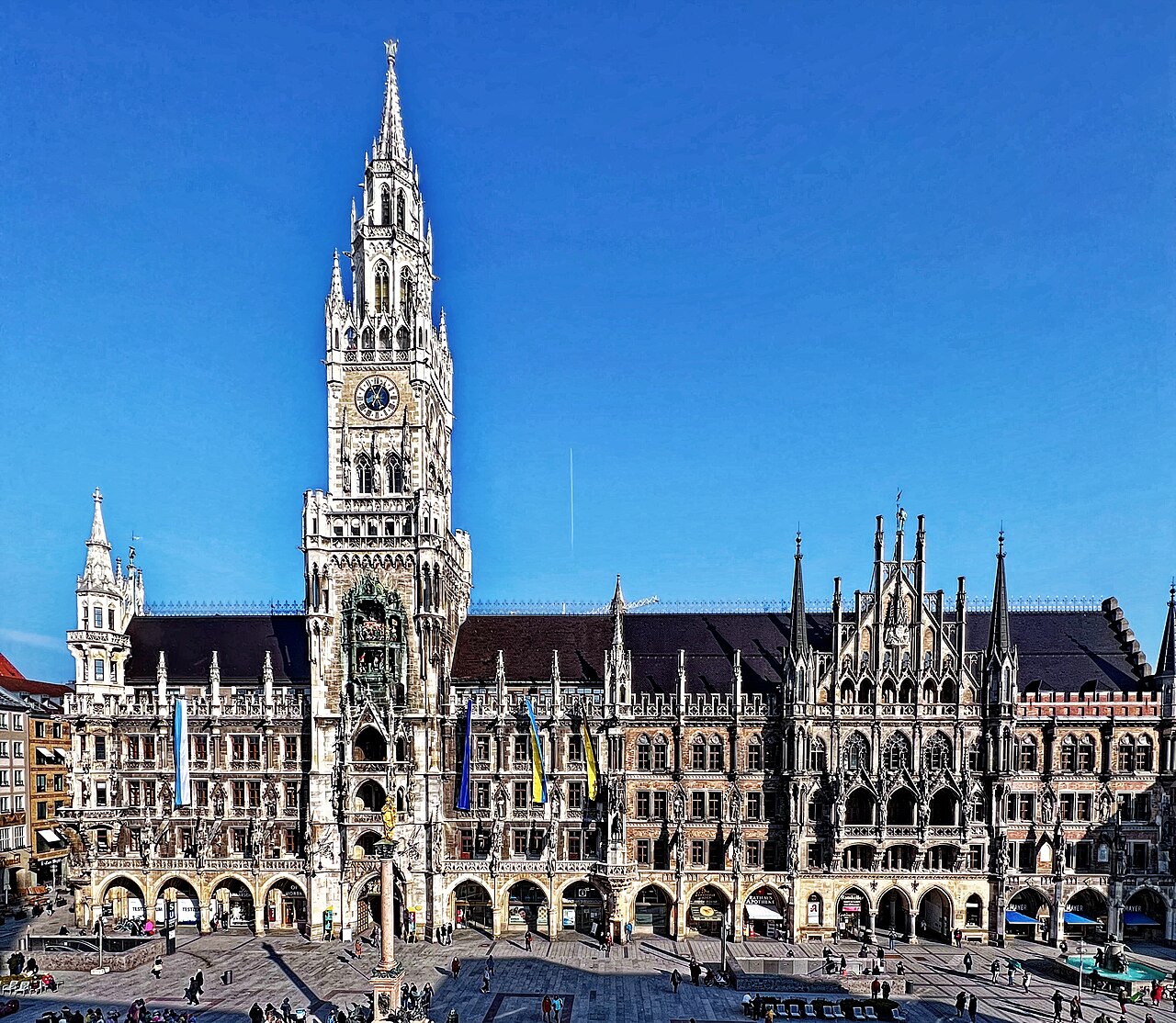
At eleven every morning, several hundred people gather in Marienplatz to watch mechanical figures rotate on the town hall facade for about twelve minutes. The Glockenspiel was installed in 1908, the figures re-enact a wedding from 1568 and a dance from the plague year of 1517, and almost everyone who watches it agrees afterwards that it was fine. Stand at the back, keep your bag in front of you, and give it four minutes rather than twelve.
Five minutes north of the square, at the point where a channel of the Isar runs under a bridge and into the Englischer Garten, there is a standing wave with a line of surfers waiting beside it. It is not a stunt laid on for visitors, it happens in February as well as July, and nobody has installed a viewing platform or started charging for it.
The Eisbach wave
Where the Eisbach channel enters the Englischer Garten, concrete blocks on the riverbed throw up a standing wave about a metre high, and people have been surfing it since the early 1970s. It runs all year. In February you will see them in full wetsuits with the air below freezing, queueing on both banks and taking turns in strict order.
The city legalised it in 2010 after decades of tolerating it. The wave is genuinely dangerous, the water is cold and fast and shallow over concrete, and there are signs saying so, but the standard of surfing is high and watching from the bridge is free.
The park itself is larger than Central Park at 375 hectares. Nudity has been permitted in designated meadows since 1984, which surprises visitors who wander into one in June.
Beer gardens, and the law about your own food
A Bavarian beer garden under the traditional rules must let you bring your own food. It comes from an 1812 decree and it survives today as a distinction between the self-service section, usually under the chestnut trees on plain benches, and the served section with tablecloths where the rule does not apply.
So: families arrive with a basket, radishes, bread, cheese and a knife, buy beer at the counter and sit down. Nobody minds. Doing it is normal, not a loophole.
The chestnut trees are there because breweries planted them over their cellars before refrigeration, for the shade, and then started serving underneath.
Beer comes in a Maß, a full litre, and there is no shame in ordering a half. Order Helles unless told otherwise, which is the pale lager Munich actually drinks; Weissbier for a wheat beer, served in a tall glass and poured slowly; and a Radler if you want it cut with lemonade, which was invented here in 1922 by a landlord who was running out of beer and had cyclists to serve.
The Hofbräuhaus is the famous one, and it is a tourist institution with a brass band and a thousand seats. The Augustiner-Keller on Arnulfstraße, with 5,000 seats under the trees, is where locals go, and its beer is still delivered to the tap by wooden barrel.
The Residenz, and how big it actually is
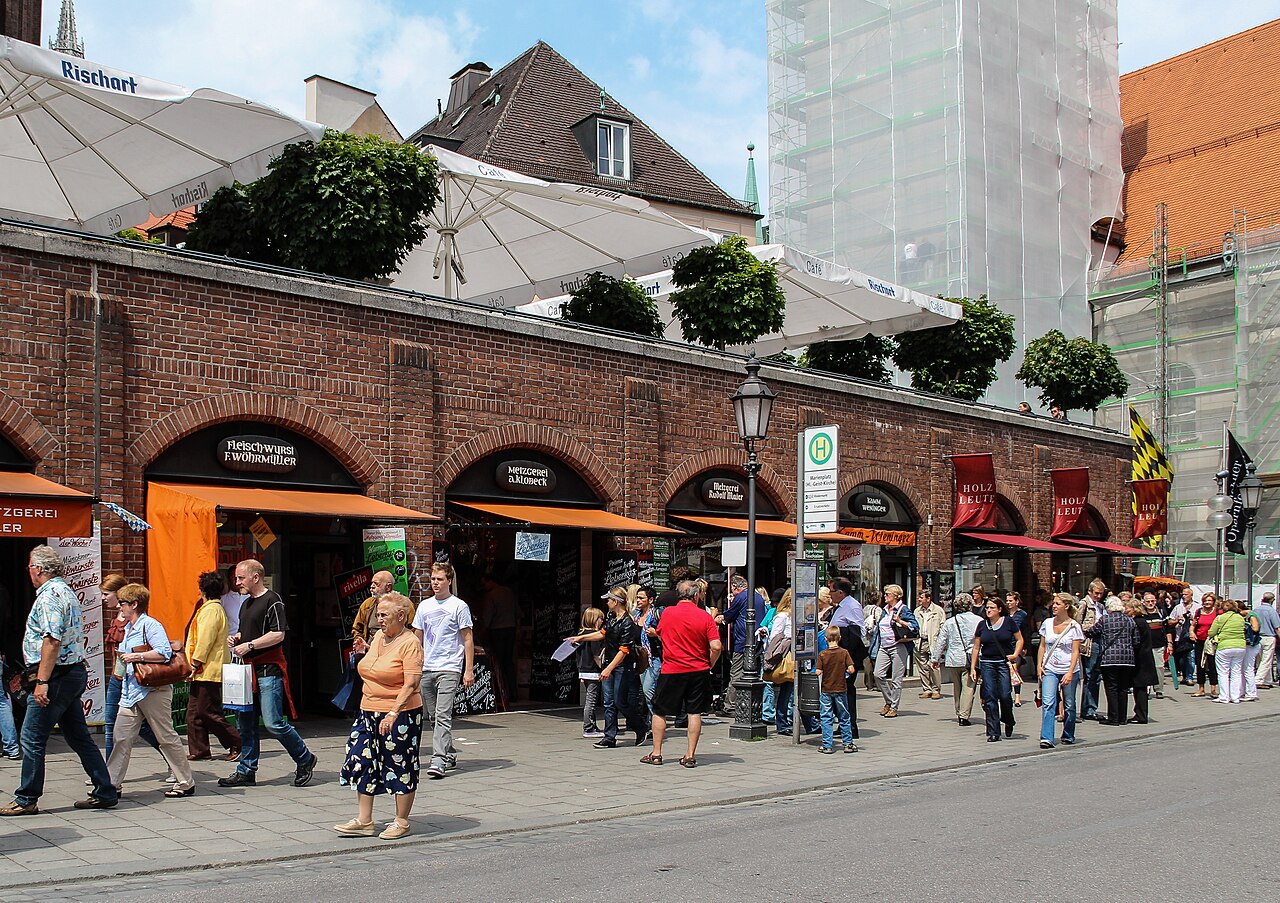
The Wittelsbach palace in the middle of Munich has 130 rooms open to the public across ten courtyards, and people go in expecting an hour and come out after three, or give up halfway.
The one room to see if you see nothing else is the Antiquarium: a barrel-vaulted hall 66 metres long, finished in 1571, lined with Roman busts and painted with 102 views of Bavarian towns as they looked in the 1580s. It is the largest Renaissance interior north of the Alps.
The Treasury is a separate ticket in the same building and holds a crown from around 1370 and a small statue of St George encrusted with 2,291 diamonds.
Nearly everything you look at was rebuilt. Munich lost about half its buildings to bombing between 1940 and 1945, and the old centre was reconstructed to its pre-war appearance rather than replaced, a decision taken by referendum-like consultation in 1946 and unusual for West Germany at the time.
What the city does not put on the postcards
Munich was where the Nazi party was founded and where it kept its headquarters, and the city spent decades not saying so. That changed in 2015 with the NS-Dokumentationszentrum, a white cube built on the site of the party’s former administrative building on Brienner Straße, four floors of documents and photographs and no artefacts at all, deliberately.
Entry is free. It takes two hours to do properly and it is not a comfortable two hours.
Dachau, the first Nazi concentration camp and the model for the rest, is 20 kilometres out and reachable on the S2 train plus a bus, about 45 minutes each way. It is a half-day, not an add-on, and there is no sensible way to combine it with a beer garden afternoon. Decide in advance which day you are giving it.
Eating between the beers
Weisswurst is a white veal sausage eaten before noon, because it was made fresh each morning in the days before refrigeration and had to be gone by midday. The rule holds in traditional places. You suck the meat out of the skin or cut it lengthways and peel it, dip it in sweet mustard, and eat a pretzel with it.
Leberkäse is neither liver nor cheese. It is a baked meat loaf, sliced thick, put in a bread roll, and sold from butchers’ counters for a few euros, and it is the standard Munich lunch on the move.
The Viktualienmarkt, running six days a week since 1807, has its own beer garden in the middle where the tap rotates between the six Munich breweries through the year.
Two hours by train down the line, Vienna and Prague are both a comfortable next stop, and Zurich is three and a half hours the other way.
Book the trip you have just read about
These are the companies we use ourselves, and what each one is actually good at.
| Provider | Best for | Go to provider |
|---|---|---|

|
Hotels & apartments The widest choice of places to sleep, and the Genius discount starts on booking number one. Read our Booking.com review | Check hotel prices at Booking.com |

|
Flights Live fares from airlines and booking sites side by side, one-click booking, and a refund guarantee you can add to any ticket. Read our Soar review | Check flight prices at Soar |

|
Whole homes A front door of your own, with a kitchen and a washing machine, for a weekend or a month. Read our Airbnb review | Check homes at Airbnb |

|
Luxury hotel perks Breakfast for two and a 4pm checkout at more than 1,900 hotels — if you hold the card. Read our American Express Travel review | See the hotels at American Express Travel |

|
Flight + hotel packages Flight, hotel and car in one basket, on one bill, with one rewards balance across three brands. Read our Expedia Group review | Check package prices at Expedia Group |

|
All-inclusive holidays Plane, hotel, transfer and excursions under one contract, with one number to call when it goes wrong. Read our TUI Group review | Check holiday prices at TUI Group |

|
Small-group tours Groups capped at around twelve, led by somebody who lives in the country you are walking through. Read our Intrepid Travel review | Check tour prices at Intrepid Travel |

|
Tailor-made itineraries A route drawn for you alone, by a company that has been drawing them since 1758. Read our Cox & Kings review | Request a quote at Cox & Kings |

|
Reviews & things to do Check what other travellers actually found, before the money leaves your account. Read our Tripadvisor review | Read the reviews at Tripadvisor |